Why Your Meal Prep Always Gets Boring by Wednesday — and the Fix That Actually Sticks
Quick Answer: Meal prep boredom usually comes from batch-cooking one full meal five times instead of prepping interchangeable components. Prepping a base protein, a base carb, and 2-3 sauces or seasoning variations lets you build different-tasting meals from the same cooking session.
Monday’s meal prep tastes great. By Wednesday, the same exact meal in the same exact container has lost all appeal — and by Friday you’re ordering takeout, undoing the whole week’s effort. The fix isn’t cooking more; it’s cooking differently.

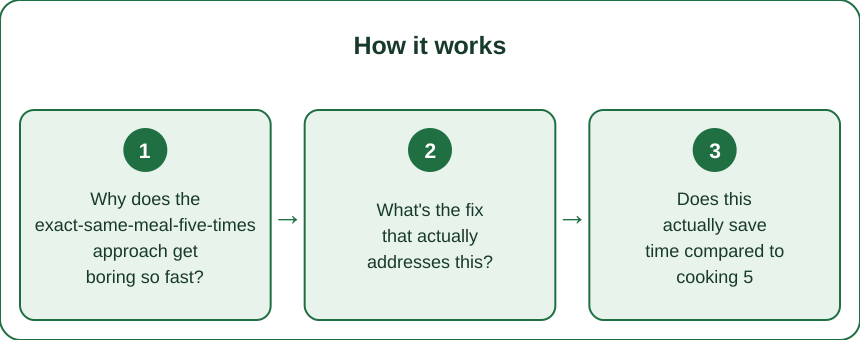
Why does the exact-same-meal-five-times approach get boring so fast?
Repetition fatigue is a real, well-documented eating phenomenon — the same flavor profile eaten repeatedly loses palatability faster than most people expect, sometimes within just 2-3 exposures in the same week. Batch-cooking one complete dish five times maximizes this fatigue, since every single variable (protein, carb, sauce, seasoning) repeats identically each day.
What’s the fix that actually addresses this?
Component-based meal prep: cook a base protein (plain, minimally seasoned), a base carb, and roasted vegetables separately, then prepare 2-3 distinct sauces or spice blends. Mixing and matching these components across the week means Monday’s bowl and Thursday’s bowl share ingredients but taste completely different — same cooking time investment, far less flavor repetition.
Does this actually save time compared to cooking 5 different full meals?
Yes, meaningfully. Cooking one batch of protein and one batch of carbs, just in larger quantity, takes barely more time than cooking a single portion — the time cost scales mostly with prep and cleanup, not raw cooking volume. Preparing 2-3 sauces takes maybe 15-20 extra minutes total, which is far less than cooking 5 entirely separate meals from scratch.

How Many Days Ahead Should You Actually Meal Prep?
3-4 days is the sweet spot for most fresh-cooked proteins and vegetables from a food safety and quality standpoint — cooked chicken, fish, and most vegetables hold well refrigerated for about 3-4 days before texture and safety both start to decline. Prepping a full 7 days at once often means the back half of the week is eating noticeably lower-quality food; splitting into two smaller prep sessions (early week, midweek) usually produces better results than one giant Sunday batch.
Does batch cooking protein risk it drying out by day 3-4?
It can, if not handled correctly. Slightly undercooking proteins meant for reheating (pulling chicken breast a few degrees before typical doneness, for instance) and reheating gently with a splash of broth or sauce prevents the dry-by-Thursday problem that’s common with meal-prepped proteins reheated in a microwave at full power with no added moisture.
FAQ: Meal Prep Variety, Answered
Is component-based meal prep more expensive than full-meal prep?
Generally not — you’re still buying the same proteins, carbs, and vegetables; the only addition is a few sauce ingredients, which are typically inexpensive relative to the whole grocery list.
How many sauces or seasoning variations are enough to prevent boredom?
Most people find 2-3 distinct flavor profiles (say, a garlic-herb, a spicy chili-lime, and a tahini-based sauce) is enough variety to make a 5-day week feel non-repetitive.
Should sauces be prepped fresh or can they be stored?
Most sauces keep well refrigerated for the same 3-4 day window as the rest of the prep, making them easy to batch alongside everything else.
TL;DR:
- Repetition fatigue, not lack of willpower, is why identical meal prep gets boring by midweek
- Prep components (protein, carb, veg) separately and mix with 2-3 sauces instead
- This takes barely more time than single-recipe batch cooking
- Prep in 3-4 day batches, not a full week, for better food quality and safety
The fix isn’t more discipline — it’s restructuring what you’re actually batching. Components beat identical meals, every time.
Keep Reading
This article is for general informational purposes only and is not medical advice. Always consult a qualified health professional for guidance specific to you.