Which Foods Should Never Go in Your Meal Prep Containers?
Quick Answer: Six categories consistently fail: dressed leafy salads, anything breaded or crispy, avocado, cut apples and pears, delicate herbs, and fried eggs. The mechanism is nearly always moisture migration - water moving from a wet component into a dry one, or out of cells that have been cut. The fix is not avoiding these foods but storing them separately and combining at the last minute, which usually costs under a minute per meal.
The rest of your prep is more robust than you think, and knowing which six things to isolate is most of the skill.
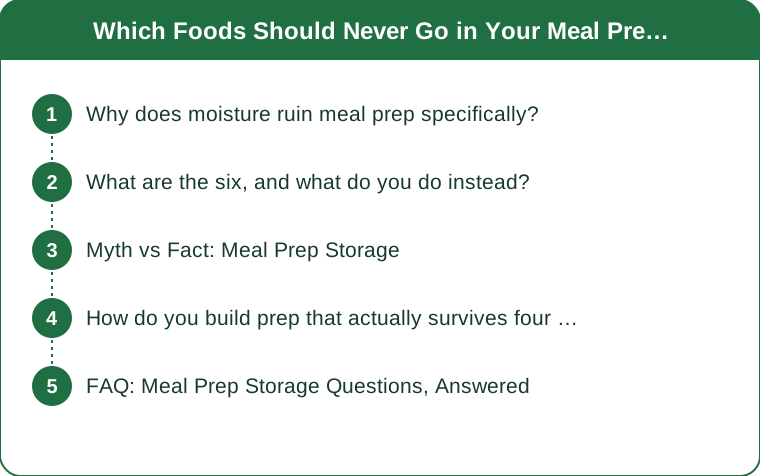
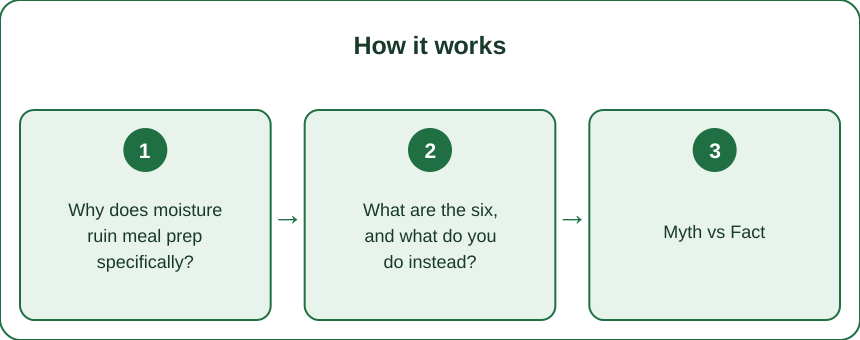
Why does moisture ruin meal prep specifically?
Because a sealed container is a closed system, and water moves toward equilibrium.
Water migrates from high-moisture to low-moisture components. Dressing on lettuce, sauce on rice, roasted vegetables against bread. Given four days, that migration completes, which is why day-four lunches taste uniformly damp.
Salt accelerates it dramatically. Salt draws water out of plant cells through osmosis. A dressed salad is not slowly absorbing dressing - it is actively losing its own water, which is why lettuce goes limp in hours rather than days.
Crisp textures depend on a dry surface, and a sealed container traps steam from anything still warm. Sealing food before it has cooled is the most common single error and it undoes otherwise good prep.
Cut surfaces oxidise and lose water fast. Cutting exposes cell interiors to air and enzymes, which is why cut apple browns and cut avocado goes grey and slimy.
And repeated reheating dries proteins while the vegetables around them get wetter. The two move in opposite directions in the same box, which is why day-four chicken is tough sitting next to vegetables that have gone soft.
What are the six, and what do you do instead?
Each has a specific workaround that takes seconds.
1. Dressed leafy salads. Lettuce collapses within hours of contact with an acidic, salted dressing. Pack the dressing in a small separate pot and add it at the table. Sturdy leaves - kale, cabbage, radicchio - are the exception and actually improve with a few hours of dressing.
2. Anything breaded or crispy. Breadcrumbs, tempura, roast potatoes with a crisp edge. These are texture-first foods and the texture does not survive. Either accept them soft or cook them fresh.
3. Avocado. Browns and softens fast even with lemon juice, which slows the enzyme rather than stopping it. Add half an avocado fresh at eating time - it takes ten seconds.
4. Cut apples and pears. Same enzymatic browning. Whole fruit packed alongside beats cut fruit inside. Citrus, berries, and grapes hold up well and are the better prep fruit.
5. Delicate herbs. Basil, coriander, dill, and parsley blacken and go slimy within a day or two of being cut and enclosed. Add them fresh - and note that hardy herbs like rosemary, thyme, and oregano are entirely fine cooked into the dish.
6. Fried and poached eggs. Reheated yolks turn rubbery and can develop a sulphurous smell. Hard-boiled eggs stored in the shell keep for about a week and are the prep-friendly version.
Myth vs Fact: Meal Prep Storage
Myth: Meal prep is only safe for three days. Fact: Most cooked dishes keep safely for three to four days at 4°C or below, and many keep longer. The limit is usually quality rather than safety - but if your fridge runs warm, or food cooled slowly, three is the sensible ceiling. Freeze what you will not eat by day four.
Myth: You should let food cool completely before refrigerating. Fact: Leaving food out to cool fully is exactly the wrong move for food safety - the danger zone is between about 5 and 60°C. Cool quickly in shallow containers and refrigerate within two hours, leaving lids ajar until steam stops.
Myth: Glass containers keep food fresher. Fact: Glass does not extend freshness meaningfully. It does not absorb odours or stain, reheats more evenly, and seals well - all real advantages, none of which are freshness. Airtightness is what matters, and good plastic seals just as well.
Myth: Reheating rice is dangerous. Fact: The risk comes from rice left at room temperature after cooking, where Bacillus cereus spores can multiply. Rice cooled quickly, refrigerated promptly, and reheated thoroughly is fine. Cool it within an hour and this stops being a concern.
Myth: Freezing ruins texture. Fact: It depends entirely on the food. Stews, curries, soups, cooked grains, and cooked meat freeze extremely well. High-water vegetables and creamy sauces do not. Freezing half the batch on day one is the best defence against day-four fatigue.
How do you build prep that actually survives four days?
Structure the boxes so the fragile parts are never inside them.
Component prep beats complete meals. Cook proteins, grains, and roasted vegetables separately and assemble each morning. This takes 90 seconds a day and it eliminates most texture problems, plus it lets you vary the combination so Thursday does not taste like Monday.
Undercook the vegetables that will be reheated. Roast to about 80 percent, since reheating finishes them. Broccoli that was perfect on Sunday is mush by Wednesday.
Use sauce as the variety lever. The same chicken, rice, and roasted vegetables becomes four different meals with a different sauce each day. Sauce stored separately in small pots is the highest-value trick in meal prep - it fixes both monotony and sogginess at once.
Front-load the fragile meals. Eat the fish and the softer vegetables on Monday and Tuesday. Save stews, curries, and chilli for Wednesday and Thursday - those genuinely improve.
Layer deliberately when you do use one box. Dressing at the bottom, then hard vegetables, then grains, then protein, then leaves at the top. Gravity keeps the moisture away from the fragile layer until you tip it out.
Cool fast and seal cold. Shallow containers, lids ajar until steam stops, fridge within two hours. This one habit does more for both safety and texture than any container upgrade.
FAQ: Meal Prep Storage Questions, Answered
How long does meal prep actually last in the fridge?
Three to four days for most cooked dishes held at 4°C or below. Quality usually declines before safety becomes a question, but rapid cooling is what makes the four-day version reliable.
Can I meal prep salad?
Yes, if the dressing is separate and the leaves are sturdy. Kale, cabbage, and radicchio hold up well and even improve. Lettuce and spinach dressed in advance collapse within hours.
Why does my meal prep taste worse by Wednesday?
Usually moisture migration and repeated reheating rather than spoilage. Component prep, undercooked vegetables, and separate sauces address nearly all of it.
Should I use glass or plastic containers?
Either, as long as the seal is genuinely airtight. Glass reheats more evenly and does not stain or hold odours; good plastic is lighter and cheaper. Neither extends freshness on its own.
Is it safe to reheat rice?
Yes, if it was cooled quickly - within about an hour - refrigerated promptly, and reheated until steaming hot throughout. The risk comes from rice left sitting at room temperature.
What freezes best for meal prep?
Stews, curries, chilli, soups, cooked grains, and cooked meat. Avoid freezing high-water vegetables and cream-based sauces, which separate and go watery on thawing.
TL;DR:
- Six things fail: dressed leafy salads, breaded or crispy food, avocado, cut apples and pears, delicate herbs, and fried eggs - store them separately, not never.
- The mechanism is moisture migration, accelerated by salt and by sealing food while it is still warm.
- Component prep plus separate sauces fixes both sogginess and Wednesday boredom in about 90 seconds a day.
- Cool fast, seal cold, refrigerate within two hours - and undercook anything that will be reheated.
- Front-load fragile meals; stews and curries genuinely improve by day four.
The useful realisation is that meal prep rarely fails because the food went off. It fails because six ingredients were in the wrong container.
Keep Reading
This article is for general informational purposes only and is not medical advice. Always consult a qualified health professional for guidance specific to you.